
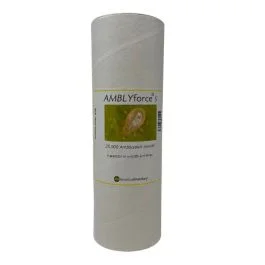
Description
Target Pest: Whiteflies, Thrips, Broad mites, Hemp russet mite
: Amblyseius swirskii adults have 8 legs and the body is a whole unit as opposed to segmented. It has relatively few hairs on its back, 20 pairs at most. A. swirskii cannot be distinguished from a number of other predatory mites such as A. cucumeris, A. californicus, or A. andersoni with the naked eye. The differences in appearance are subtle and can only be seen under microscope. The color of A. swirskii is dependent on what the mites have been eating. This can vary from dark red to purple, to light yellow. With thrips and whitefly as prey, the color tends to be a kind of light orange. The mites feed by piercing small arthropod prey or grains of pollen with their mouthparts, and draining the contents.
Use in Biological Control: Amblyseius swirskii is a predatory mite native to the coastal regions of the Middle East and North Africa on fruit trees. It is an ideal product to be used in crops that are grown under protection in warm conditions, such as peppers, cucumbers, gerbera and aubergine. It can be used on other crops during the summer, provided that average daytime temperatures exceed 20 °C. It breeds extremely quickly under warm and humid environmental conditions. It predates on thrips, whiteflies and other pests. In the absence of prey it can also survive on the plant by feeding on pollen and mold. It prefers a warm and humid climate, but can survive cooler nights during the winter months in semi-protected crops by moving lower down the plants where it benefits from the warmer micro-climate closer to the ground. This mite is available in a Gemini and hooked sachets, which allows quick and easy introductions into the crop. The mite will emerge onto the crop looking for prey.
Life Cycle: Adult female mites lay single eggs onto leaf hairs. The mites go through three immature stages: larva, protonymph, and deutonymph, before becoming adults. At 25 °C, the entire cycle from egg to adult can take less than 7 days. All mobile stages are predatory. Release Rates: Lift each sachet from the box, pinch the join so that the printed face is outwards and drop the sachet over the crop wire, branch or leaf stalk. Do not hang adjacent to heating pipes. Duration of the sachet activity is 2-4 weeks, though longer lasting control may be evident if the mites establish in the crop. Sachets should be used at one per 2 meters of crop row.
For Best Results: Introduce Amblyseius swirskii early in the crop/pest cycle to protect against the pest build up, but only when average temperatures are above 20 °C. Before application, keep the product out of direct sunlight. Transport and store above 10-15 °C. Use within 18 hours of receipt.
Introduction Rates: Hang sachets into the crop at rates of 0.25 – 1/m². Gemini sachets are suitable for use over the leaf petiole, or can be hung on crop wires amongst foliage.


Reviews
There are no reviews yet.